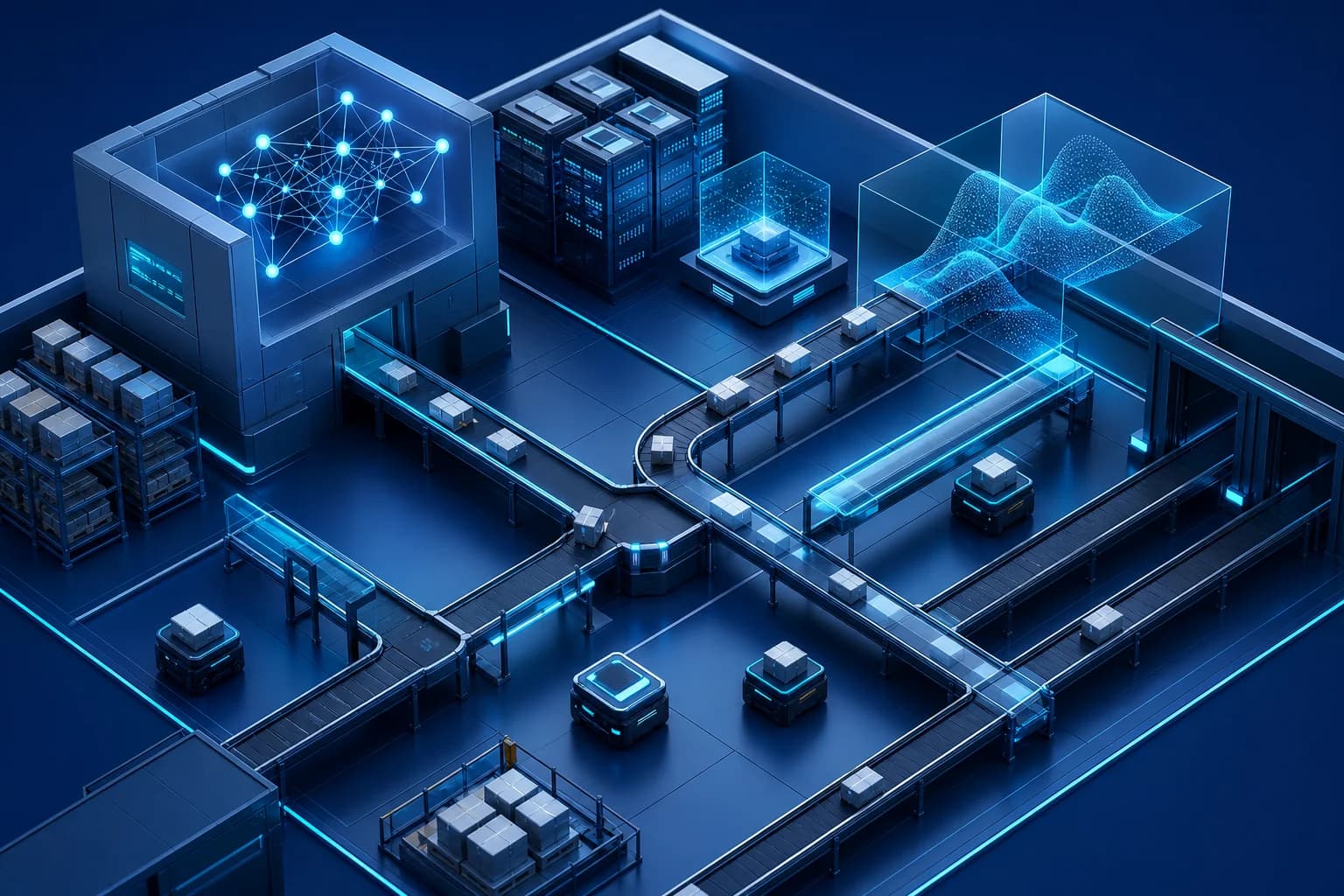
Modern fulfillment infrastructure increasingly relies on computer vision to preemptively identify conveyor blockages, shifting the operational paradigm from reactive stoppage recovery to predictive flow management. As US parcel volumes reached 23.1 billion shipments in 2025, according to data from NEDCO, the mechanical stress on high-speed sortation lines has necessitated more sophisticated monitoring than traditional photo-eye sensors can provide.
The primary mechanism for these failures involves merge and singulation errors, where package geometry—such as polybags or mixed-SKU parcels—causes timing drift at high-velocity junctions. Mechanical degradation, including bearing failure and belt misalignment, further compounds these risks, often resulting in significant throughput losses. Research from Connixt indicates that unplanned downtime can cost facilities approximately $108,000 per hour, highlighting the financial imperative for early intervention.
Computer vision systems address these challenges by monitoring for skewed cartons or density anomalies five seconds before a physical jam occurs. This predictive capability allows sortation controllers to adjust flow rates dynamically, maintaining the singulation required for efficient processing. According to the MHI Blog, the transition toward continuous, frame-by-frame monitoring enables the classification of conditions that rule-based logic cannot effectively encode.
Development teams often utilize YOLO architectures, such as v8 and v11, to draw bounding boxes around parcels and track their trajectory via Intersection-over-Union overlap. Scientific Reports research confirms these models can achieve 95.65% detection accuracy at 30.5 fps for identifying belt damage. The unified architecture of YOLO provides the necessary balance of inference speed and spatial precision for real-time industrial applications, allowing for the rapid classification of package types including totes, envelopes, and trays.
Benchmarking these models requires rigorous testing against synthetic datasets to ensure robustness in variable lighting and occluded environments. Azumo’s development team, for instance, evaluated multiple YOLO variants and OCR engines against 600 synthetic training images to achieve a mean average precision above 80%. This benchmark-first approach ensures that the vision system remains resilient to the constant SKU mix changes inherent in modern e-commerce fulfillment.
Alternative approaches leverage training-free, object-agnostic methods to handle novel container types without requiring constant manual annotation. Research published on arXiv demonstrates that sampling reference points in empty monitoring regions allows for the detection of persistent occlusions with high F1 scores. By establishing a baseline of the empty belt, the system can identify any object that remains stationary beyond a temporal threshold, effectively flagging a jam without needing to recognize the specific object type.
Autoencoders further enhance this capability by reconstructing input images and flagging high reconstruction error as anomalies, effectively identifying mechanical failures like fractured gears that do not conform to predefined classes. Because the model is trained to reconstruct healthy belt conditions, any deviation—such as a worn splice or a damaged divert paddle—results in a high reconstruction error. This method is particularly effective for catching failures that are too rare or too visually subtle to be captured by standard supervised classification models.
Hardware integration typically involves a combination of RGB area cameras, 3D scanners, and thermal sensors to capture specific failure modes. Edge computing platforms, such as the NVIDIA Jetson AGX Orin, provide the necessary 275 TOPS of performance to execute inference directly on the belt. This integration allows for automated feedback loops with SCADA and PLC systems, enabling instantaneous adjustments to belt speed and the generation of maintenance work orders.
The significance of these deployments lies in the ability to catch failure signatures weeks before catastrophic stoppage occurs. By identifying vibration patterns or heat signatures in bearings, operators can transition to a condition-based maintenance schedule. This proactive strategy minimizes the reliance on emergency repairs and reduces the frequency of SLA penalties associated with delayed parcel processing.
Integrating these vision systems into the broader facility management stack creates a closed-loop system where data informs physical maintenance. When the vision AI identifies a worn bearing or a misaligned belt, it triggers an alert in the Computerized Maintenance Management System, or CMMS, to schedule repairs during off-peak hours. This capability transforms maintenance from a reactive, time-based schedule into a data-driven, condition-based operation that protects overall system throughput.
Future developments in this domain will likely focus on the integration of multimodal sensor fusion to improve detection robustness in variable lighting and high-density environments. As facility operators like Amazon continue to scale their robotic fleets, the reliance on high-fidelity vision layers will remain the primary constraint on throughput. Monitoring the evolution of these architectures will be essential for understanding the next generation of automated logistics efficiency.