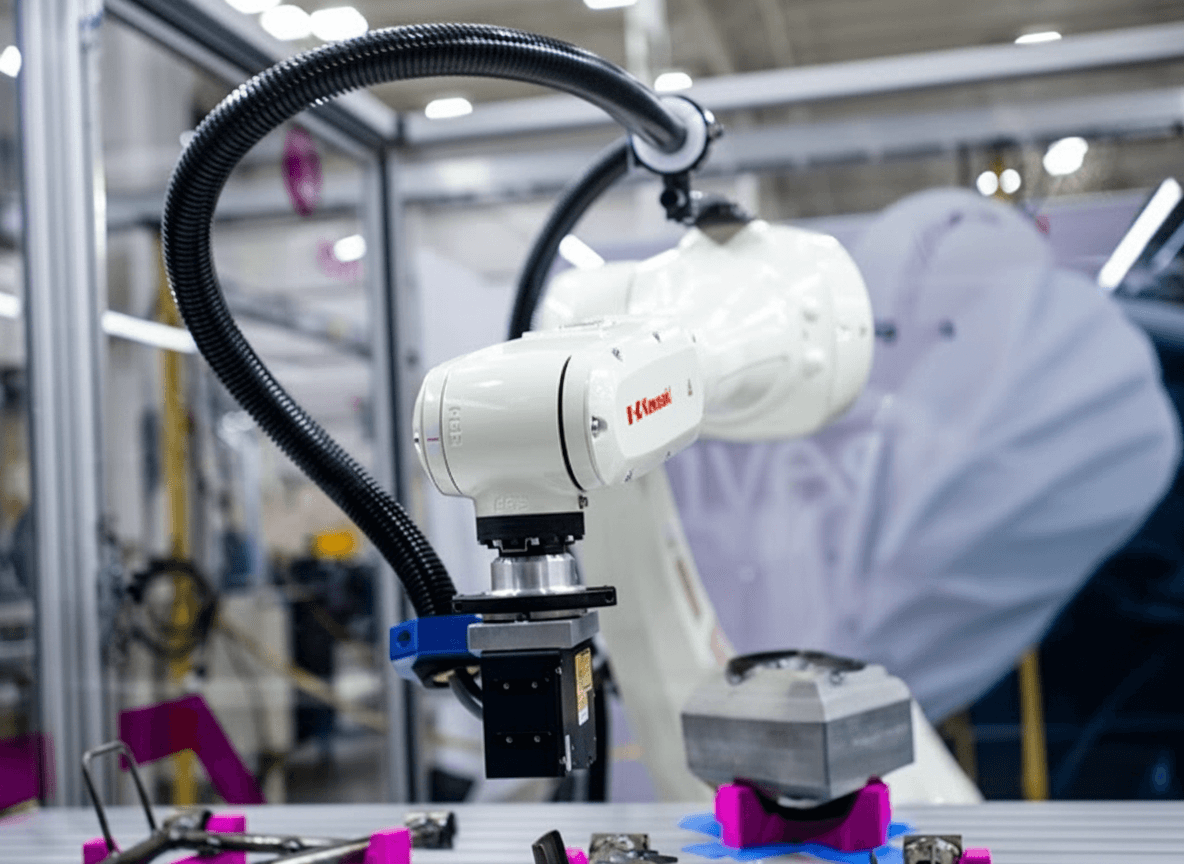
Kawasaki Robotics introduced the RL030N 8-axis robot platform at Automate 2026 in Chicago, marking a shift toward hardware specifically engineered for physical AI applications. This system integrates high-speed motion control with an open API architecture to facilitate direct interaction between external machine learning models and physical actuators.
The RL030N architecture utilizes an additional articulation axis compared to traditional 6-degree-of-freedom systems, which increases dexterity for confined-space manipulation. Seiji Amazawa, president of Kawasaki Robotics, stated that the platform is designed to bridge the gap between perception and physical execution. The system relies on the KRNX real-time control API to allow ROS environments and third-party vision platforms to bypass standard controller limitations. This open-access design supports dynamic motion planning, which is essential for tasks requiring real-time obstacle avoidance and adaptive path adjustment. The lightweight construction of the unit further enables rapid acceleration profiles necessary for high-frequency AI-driven decision cycles.
Beyond the RL030N, the company showcased its Pulseboard technology, a tool-tip displacement output function developed alongside Fives DyAG. This system synchronizes laser 3D profile imaging with the robot’s internal displacement data to maintain high-resolution inspection during active motion. Wade Rickard, CEO of Fives DyAG Corp, noted that the integration allows for high-speed weld inspection without the latency typically introduced by stop-and-go image acquisition. By correlating sensor data with real-time motion states, the system achieves a tenfold increase in inspection throughput. This methodology reduces the reliance on static inspection stations, allowing for continuous quality monitoring on high-speed production lines.
The demonstration of the BU015X 7-axis robot in a closed-loop dispensing application highlights the use of machine learning for process optimization. Working with Coherix, Kawasaki Robotics implemented 3D laser-based Adaptive Process Control to manage sealant application on automotive components. The system performs real-time bead placement adjustments at a frequency of 400 Hz, utilizing feedback loops to minimize material waste and rework. Scott Childs, senior director of the automotive group at Kawasaki Robotics, described this as a shift toward intelligent manufacturing where process control is embedded directly into the robotic motion stack. The integration of hollow-arm design with high-speed sensor feedback allows for precise control in environments where traditional rigid programming fails to account for surface variability.
The company also expanded its industrial portfolio with the BA013L arc welding robot and the MXP360L heavy-duty manipulator. The BA013L features a 50 mm hollow wrist for internal cable routing, which mitigates mechanical wear during high-current welding operations. With axis speeds reaching 730°/s and a reach of 2,093 mm, the unit is optimized for cycle-time reduction in dense welding cells. The MXP360L, capable of handling 360 kg payloads, demonstrates the application of advanced vibration-control algorithms for heavy-duty material handling. These additions suggest a broader strategy to standardize high-performance motion control across both specialized AI-driven tasks and traditional heavy-duty manufacturing.
The reliance on the KRNX API indicates a strategic move toward modular robotics, where the controller acts as a transparent interface for external software stacks. This decoupling of motion planning from proprietary firmware allows researchers and engineers to deploy custom inference models directly onto the hardware. The success of these deployments will likely depend on the latency performance of the external orchestration systems during complex, multi-axis maneuvers. Future developments will focus on the stability of these closed-loop systems when subjected to high-frequency sensor noise in industrial environments.
The industry is now observing a transition from static, pre-programmed robotic sequences to dynamic systems that rely on continuous sensory input. The integration of Pulseboard and Adaptive Process Control technologies suggests that the next phase of industrial automation will prioritize real-time data fusion over simple repeatability. Stakeholders should monitor the adoption rate of the KRNX API among third-party AI developers, as this will determine the ecosystem’s growth. The ability to maintain production-line speeds while performing complex, AI-driven adjustments remains the primary benchmark for the viability of these next-generation systems.