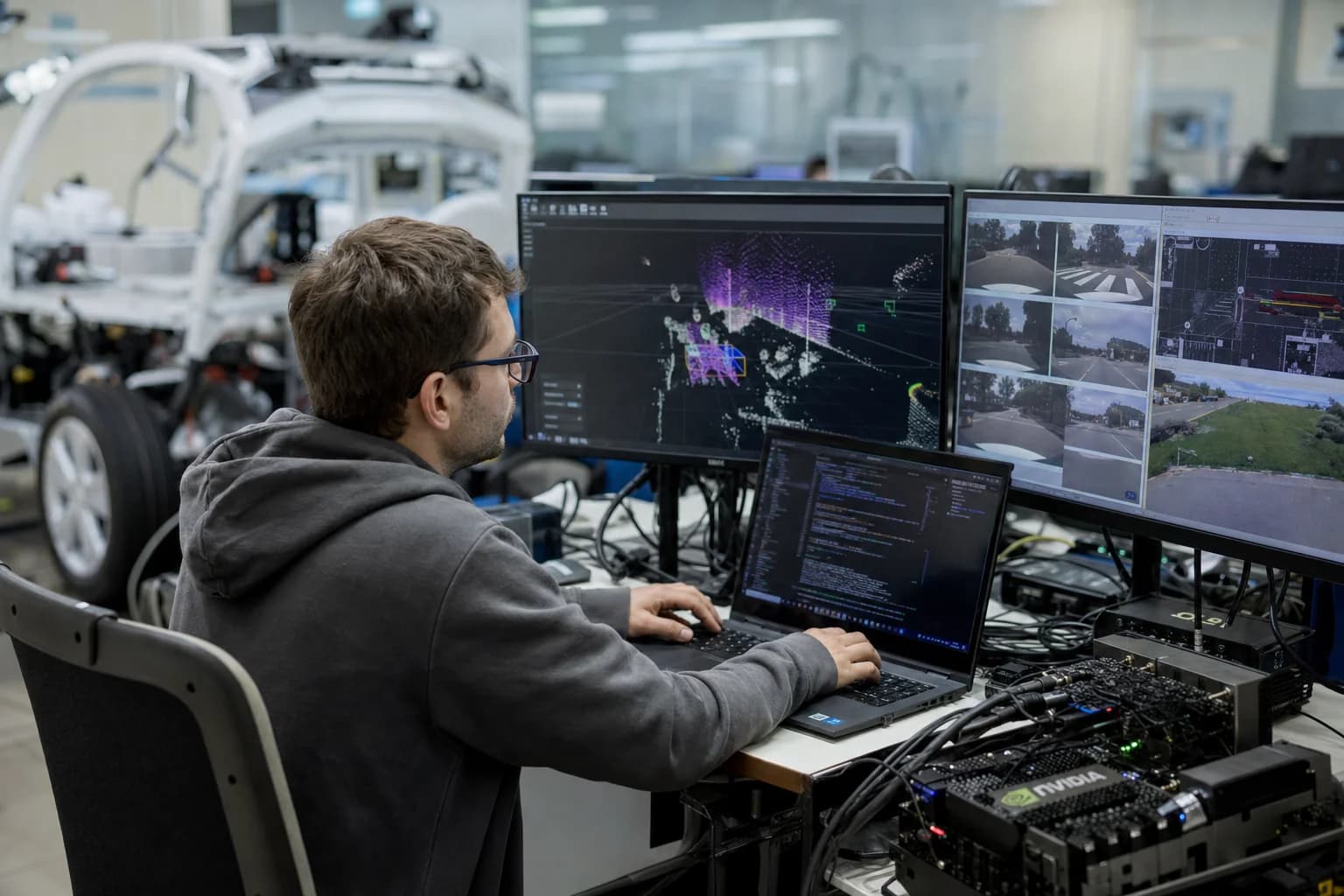
NVIDIA has transitioned its 34-billion-parameter Alpamayo 2 Super autonomous-driving model from a research-only asset to a commercially available foundation model. This release allows vehicle developers to fine-tune, modify, and redistribute the reasoning model under the Linux Foundation’s OpenMDW-1.1 license.
The architecture integrates full-surround visual perception, driving reasoning, and trajectory generation within a single unified framework. By combining NVIDIA’s 32-billion-parameter Cosmos 3 Super Reasoner with a 2-billion-parameter diffusion-based Action Expert, the system processes multi-camera video streams alongside language context and historical movement data. This approach marks a departure from modular pipelines where perception and planning often operate as isolated analytical components.
The model generates a comprehensive suite of outputs, including planned trajectories, high-level maneuver classifications, and Chain-of-Causation reasoning traces. These traces provide engineers with a transparent link between observed environmental stimuli and the resulting vehicle intent. Such interpretability is particularly critical for addressing long-tail edge cases where standard training data often lacks sufficient representation.
NVIDIA reports that Alpamayo 2 Super achieved a LingoQA score of 79.2, placing it at the top of a 37-model benchmark evaluation. The model serves as a teacher system, capable of generating reasoning auto-labels for large-scale sensor datasets. This capability reduces the time required for annotation tasks from months to days by grounding responses directly in camera imagery.
The model utilizes high-performance training methodologies, leveraging massive synthetic datasets to simulate rare road interactions that are difficult to capture in real-world driving. By employing advanced distillation techniques, NVIDIA enables developers to compress the 34-billion-parameter reasoning capabilities into smaller, specialized models optimized for real-time inference on edge hardware. These optimized models retain the core decision-making logic of the larger foundation model while meeting the strict power and latency requirements of the NVIDIA DRIVE AGX Thor platform.
The OpenMDW-1.1 licensing framework provides developers with legal clarity regarding intellectual property boundaries. Unlike traditional software licenses, this framework covers the entirety of the model distribution, including trained parameters, architecture, and associated documentation. Autonomous vehicle firms can now integrate the model into their proprietary development workflows without facing restrictive field-of-use limitations.
Engineering teams can utilize the model as an offline data engine to process fleet-accumulated sensor data. By distilling the reasoning capabilities of the 34-billion-parameter model into smaller, optimized versions, developers can deploy high-performance driving policies onto hardware such as the NVIDIA DRIVE AGX Thor. This workflow maintains the computational intensity of frontier-scale reasoning within the data center while meeting the real-time latency requirements of on-vehicle inference.
The Alpamayo family includes the 10-billion-parameter Alpamayo 1 and 1.5 versions, which serve as smaller alternatives for specific deployment scenarios. The 34-billion-parameter Super version remains the most capable reasoning model in the range, specifically designed for complex decision-making tasks that require high-level contextual awareness. This tiered approach allows developers to select the appropriate model scale based on their specific hardware constraints and performance requirements.
NVIDIA’s decision to adopt the OpenMDW-1.1 framework reflects a strategic move to standardize the distribution of AI models in physical robotics. By allowing firms to retain control over their derivative models, NVIDIA enables companies to protect the proprietary knowledge gained through fleet-specific fine-tuning. This model-centric strategy provides a scalable path for managing the immense data requirements inherent in autonomous systems.
The reliance on Chain-of-Causation outputs offers a new diagnostic tool for validation and safety testing. While these traces do not reveal the entirety of the underlying neural computation, they provide a consistent artifact for assessing system reliability. Engineers can now cross-reference visual grounding with high-level maneuvers to verify that the model’s internal logic aligns with established safety parameters.
Future development cycles will focus on the integration of these reasoning traces into standardized safety verification protocols for autonomous fleets. Researchers are currently preparing to deploy these distilled models in diverse, real-world traffic environments to measure performance against traditional, non-reasoning-based architectures. The transition from simulation-based validation to on-road testing represents the next major milestone for developers utilizing the Alpamayo 2 Super foundation.