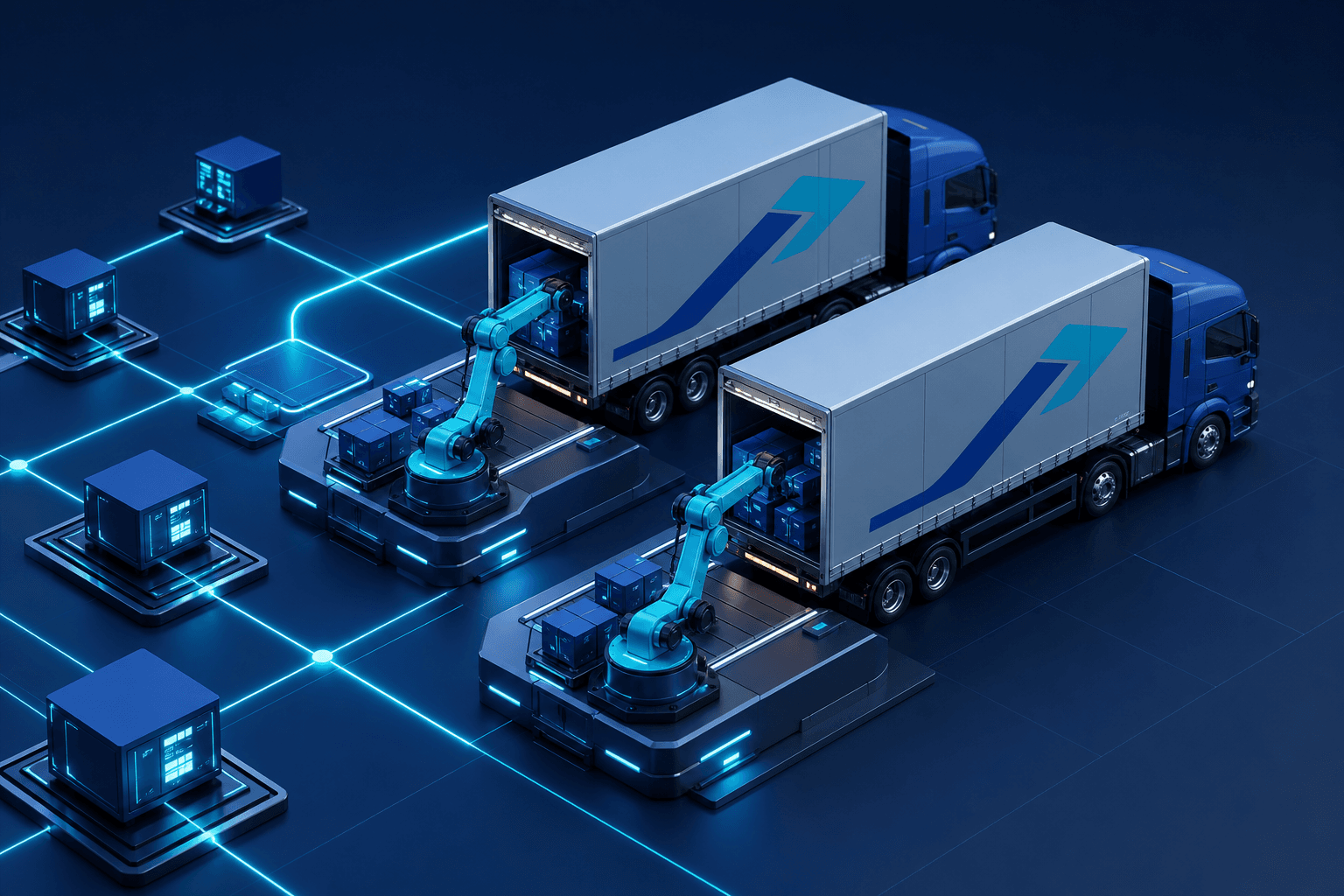
FedEx and Amazon are accelerating the integration of sophisticated robotic manipulation systems into their fulfillment networks to address the high-entropy requirements of autonomous trailer loading. On July 30, FedEx confirmed the deployment of dual-armed Mech systems at its Hagerstown, Maryland hub, utilizing the Foresight model to optimize spatial placement of heterogeneous packages in real-time.
The Foresight architecture functions as a decision-making engine that processes visual data to navigate the constraints of unstructured trailer environments. By leveraging real-time sensor feedback, the system manages the complex physics of package stacking, which has historically resisted traditional automation due to the requirement for high-level spatial reasoning and endurance. FedEx has maintained a multi-year testing cycle with Dexterity to refine these manipulation capabilities before moving toward broader network implementation.
Kawal Preet, executive vice president of planning, engineering and transformation at FedEx, outlined a roadmap during the company’s 2026 Investor Day in February to scale these automated loading and unloading operations. The objective involves equipping thousands of dock doors across more than 20 U.S. hubs with similar robotic infrastructure. This transition represents a shift from static automation to adaptive systems capable of handling the variability inherent in parcel logistics.
Amazon is simultaneously scaling its own fleet of robotic arms, with plans to more than double its current deployment throughout 2026. Brian Olsavsky, senior vice president and chief financial officer at Amazon, confirmed this expansion during a July 30 earnings call as part of a broader strategy to enhance fulfillment efficiency. The company has integrated over 1 million robots into its global network since 2012, utilizing specialized systems such as Cardinal and Sparrow for high-speed object manipulation.
The Cardinal and Sparrow systems rely on advanced computer vision and machine learning models to identify, lift, and sort items from containers into totes. These robotic arms demonstrate the efficacy of integrating deep learning with physical actuators to perform tasks that previously required human-level dexterity and decision-making. Amazon’s continued investment in these platforms reflects a commitment to reducing the reliance on manual labor for physically taxing workflows.
The rapid adoption of these technologies by logistics leaders is fundamentally altering the industrial robotics market. Aaron Prather, director of market intelligence at the Association for Advancing Automation, noted that non-automotive sectors have recently overtaken the automotive industry as the primary purchasers of industrial robotic systems. This shift is driven by the necessity for logistics firms to solve complex, high-volume material handling problems through persistent automation installs.
Other major logistics entities are following similar trajectories to optimize their sorting and unloading capabilities. The U.S. Postal Service recently implemented a parcel robotic sorting system in a Kansas distribution center, while DHL has committed to deploying over 1,000 units of the Boston Dynamics Stretch robot. These deployments underscore a growing industry consensus that physical AI is the primary mechanism for achieving operational scalability in modern supply chains.
The integration of these systems highlights the technical challenges of deploying AI in environments where the state space is constantly changing. Unlike controlled manufacturing settings, trailer loading requires the system to adapt to unpredictable package geometries and orientations. The success of these implementations will likely depend on the continued improvement of real-time inference speeds and the robustness of computer vision models in high-throughput environments.
Future developments will likely focus on increasing the autonomy of these agents and reducing the need for human intervention in edge cases. As these systems become more reliable, the focus will shift toward standardizing the communication protocols between robotic arms and warehouse management systems to ensure seamless fleet coordination. Industry stakeholders will monitor the performance metrics at the Hagerstown hub as a key indicator of the feasibility of large-scale physical AI deployment.