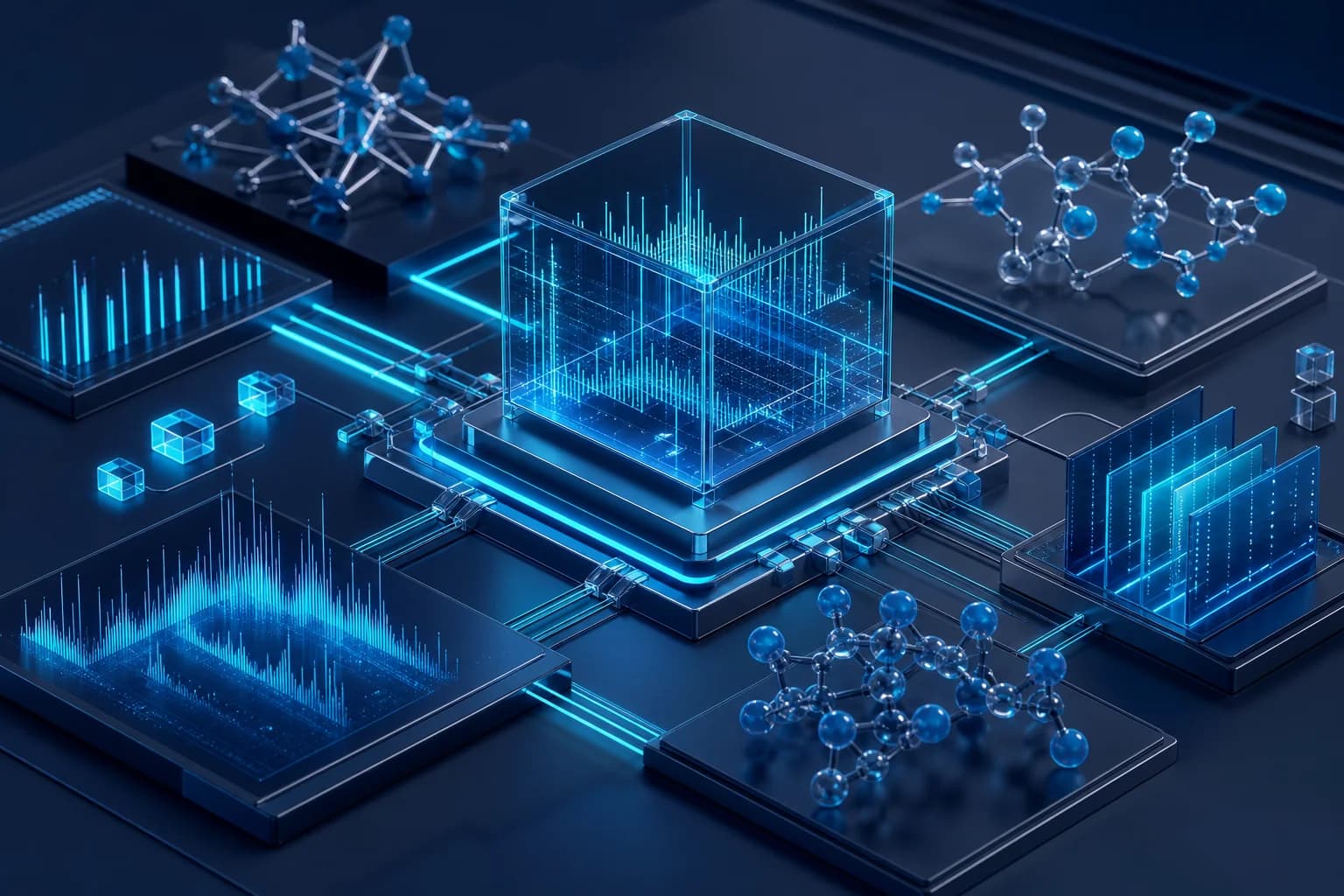
Spectroscopy serves as the primary diagnostic interface for the physical sciences, yet its integration into modern machine learning pipelines remains fragmented. Yi Luo of the Hefei National Research Center for Physical Science at the Microscale, University of Science and Technology of China, proposes a shift in how these signals are processed in a Comment published on August 24, 2026, in Precision Chemistry.
The framework conceptualizes spectral data as a series of physical tokens, drawing a direct parallel to the tokenization methods that underpin modern large language models. By treating absorption, emission, and diffraction signals as discrete units of information, researchers can encode the underlying quantum mechanical constraints of matter into a format compatible with generative AI architectures. This approach moves beyond traditional pattern matching, which often relies on curated reference databases or computationally expensive quantum-chemical simulations.
Physical tokens are defined across three hierarchical levels to ensure both experimental accuracy and computational utility. At the quantum level, these tokens represent transitions governed by energy structures and selection rules, while at the experimental level, they manifest as specific line-shape patterns, intensities, and spectral shifts. For machine learning applications, these signals are discretized into spectral intervals or latent representations, allowing models to process complex physicochemical interactions as a multidimensional language.
The syntax of this language is derived from the relationships between spectral position and environmental response, which encode the fundamental behavior of materials. By mapping these relationships, AI systems can learn the grammar of molecular structures, enabling a transition from passive characterization to active, spectrum-guided inverse design. This methodology allows a target function to be translated into a theoretical spectral blueprint, providing a roadmap for generative models to propose candidate structures.
Compared to existing baseline methods in materials informatics, which often struggle to reconcile high-dimensional spectral data with discrete structural descriptors, this tokenization approach offers a more direct mapping. Traditional models frequently require extensive feature engineering to reduce spectral noise, whereas the token-based framework preserves the physical integrity of the signal by treating it as a native data type. This preservation of information density allows for more robust training on smaller, high-quality datasets compared to the massive, unstructured corpora required by standard deep learning models.
Synthesis and spectroscopic validation complete the closed-loop cycle, where experimental results are fed back into the model to refine future design iterations. This integration transforms spectroscopy from a post-experiment fingerprinting tool into an active information substrate that connects physical laws with automated synthesis. The framework necessitates the development of high-quality, multimodal spectral databases covering infrared, Raman, nuclear magnetic resonance, and X-ray techniques.
The significance of this approach lies in its potential to standardize the interaction between computational models and robotic laboratories. By establishing a unified, machine-readable language for matter, the framework provides the necessary infrastructure for self-driving laboratories to operate with greater autonomy. Human researchers define the high-level goals, while the AI manages the candidate pathways and experimental execution, using real-time spectral feedback to adjust the trajectory of discovery.
This methodology addresses the persistent challenge of linking spectral features, physical laws, and generative design within a single, coherent architecture. It forces a departure from siloed analytical techniques toward a more holistic integration of data-driven discovery and fundamental physics. The reliance on physically grounded tokens ensures that the generative process remains constrained by the laws of nature, reducing the risk of proposing chemically impossible candidates.
Future development of this framework will likely focus on the standardization of multimodal spectral datasets and the refinement of physics-informed generative models. As these pipelines mature, the ability to translate desired material properties into specific spectral signatures will become a critical capability for accelerated materials development. The framework aims to establish a fully automated pipeline where observation, interpretation, and design operate as a unified, continuous process.