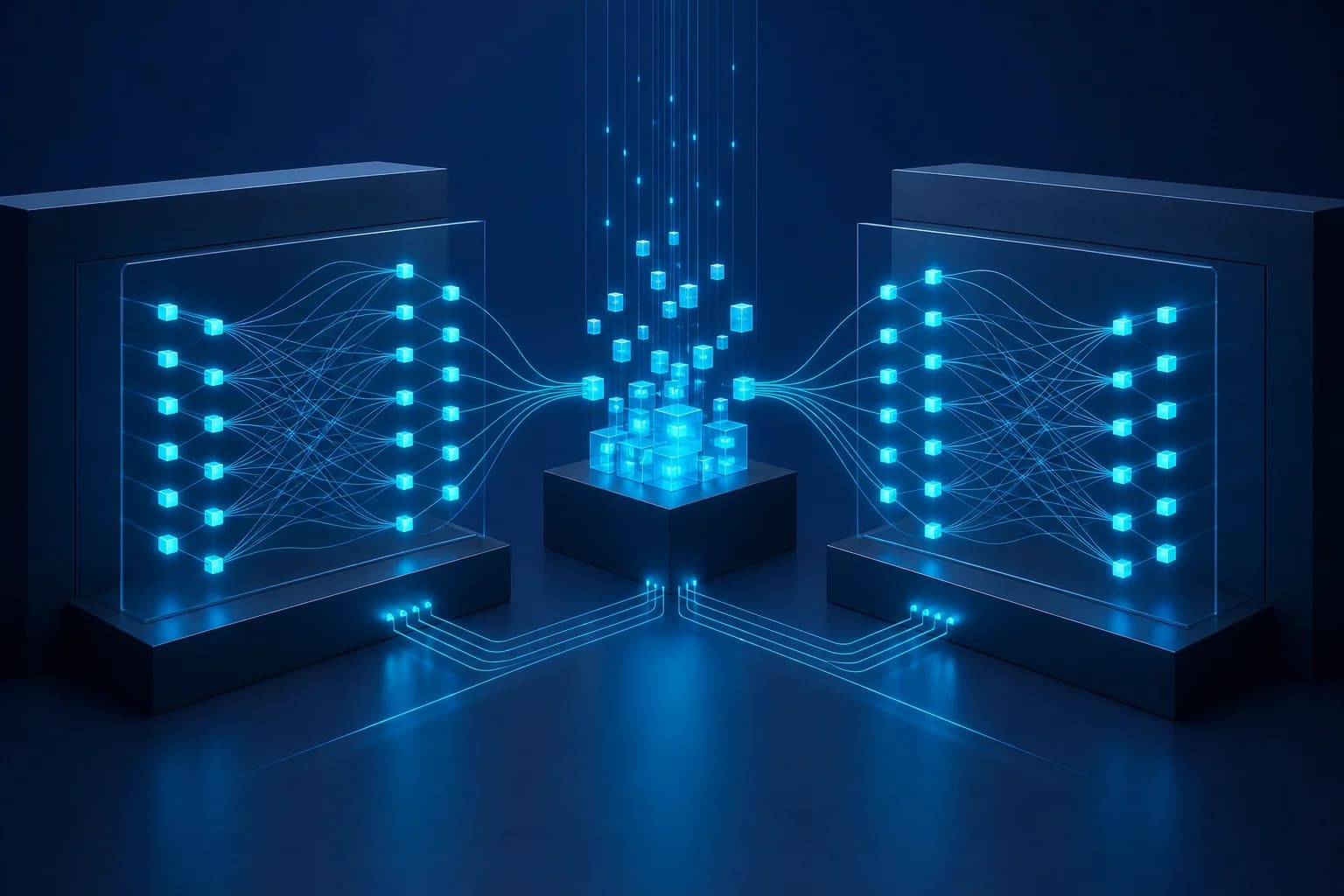
A research team led by Borja Aizpurua at Multiverse Computing has developed a method to integrate quantum circuit blocks into large language models, addressing the escalating memory constraints associated with classical parameter scaling. The findings, detailed in a recent preprint on the arXiv server, suggest that quantum-enhanced architectures can achieve performance gains without the proportional increase in physical memory requirements typical of traditional model expansion.
Large language models rely on vast arrays of adjustable parameters to process and generate natural language, with state-of-the-art systems now reaching into the trillion-parameter range. This dependency creates a linear relationship between model capability and hardware infrastructure costs, as each parameter necessitates dedicated physical memory for storage and computation. The researchers sought to decouple this relationship by utilizing the compact mathematical encoding capabilities inherent in quantum circuits.
The hybrid system architecture maintains the primary model on standard classical hardware while offloading specific computational tasks to quantum processors. In this study, the team utilized IBM’s 156-qubit superconducting quantum processor to execute the quantum components. By inserting these small quantum circuit blocks into the inner layers of a pre-trained model, the researchers effectively increased the model’s expressive power without adding the massive parameter counts required by classical fine-tuning methods.
Testing on the Llama 3.1 8B model, developed by Meta, yielded a 1.4% reduction in perplexity, a metric that quantifies the model’s predictive accuracy for subsequent tokens in a sequence. This improvement was achieved through the addition of only 6,000 parameters, representing an increase of less than 0.0001% to the total model size. Such efficiency highlights the potential for quantum-assisted layers to optimize performance in resource-constrained environments.
The team further validated their methodology using SmolLM2, a 135-million-parameter model, to conduct a systematic analysis of quantum component scaling. Results indicated a consistent performance improvement correlated with the size of the quantum blocks. The quantum-enhanced version of the model demonstrated superior accuracy on specific queries compared to its purely classical counterparts, which failed to produce correct outputs in the same test scenarios.
The specific architecture utilizes Cayley Unitary Adapters, which serve as the bridge between classical neural network layers and the quantum processor. These adapters allow the model to map high-dimensional data into a quantum state space, where complex correlations are captured through unitary transformations. This mathematical approach allows for the representation of intricate patterns that would otherwise require a significantly larger number of classical weights to approximate.
By offloading these specific operations to the quantum hardware, the researchers avoid the memory bottleneck that typically occurs when increasing the depth of a neural network. The quantum circuit acts as a highly efficient feature extractor that operates in parallel with the classical layers. This synergy ensures that the model maintains its original training speed while benefiting from the enhanced representational capacity of the quantum-enhanced components.
Current performance gains remain modest, constrained primarily by the fidelity and qubit counts of contemporary quantum hardware. Despite these limitations, the successful implementation on widely recognized models provides a proof of concept for hybrid quantum-classical architectures in natural language processing. The researchers anticipate that as quantum hardware matures, these performance improvements will scale, potentially offering a sustainable pathway for developing advanced models.
The integration of quantum circuit blocks represents a departure from the traditional approach of simply increasing model depth or width to improve performance. By leveraging the unique properties of quantum states to represent complex relationships, this method addresses the fundamental bottleneck of memory-intensive parameter storage. This shift could redefine how engineers approach the optimization of high-capacity models in the future.
Future development will likely focus on the optimization of these hybrid workflows to reduce latency and improve the integration between classical and quantum processing units. As researchers continue to refine the interface between these two computational paradigms, the ability to achieve higher model performance with lower infrastructure overhead may become a critical factor in the evolution of machine learning systems.
The team is now looking toward testing these architectures on even larger models to determine the upper limits of the quantum-classical advantage. Monitoring the evolution of quantum processor coherence times and error rates will be essential for assessing the long-term viability of this approach. These upcoming milestones will determine whether quantum-enhanced adapters can become a standard component in the next generation of large-scale AI development.