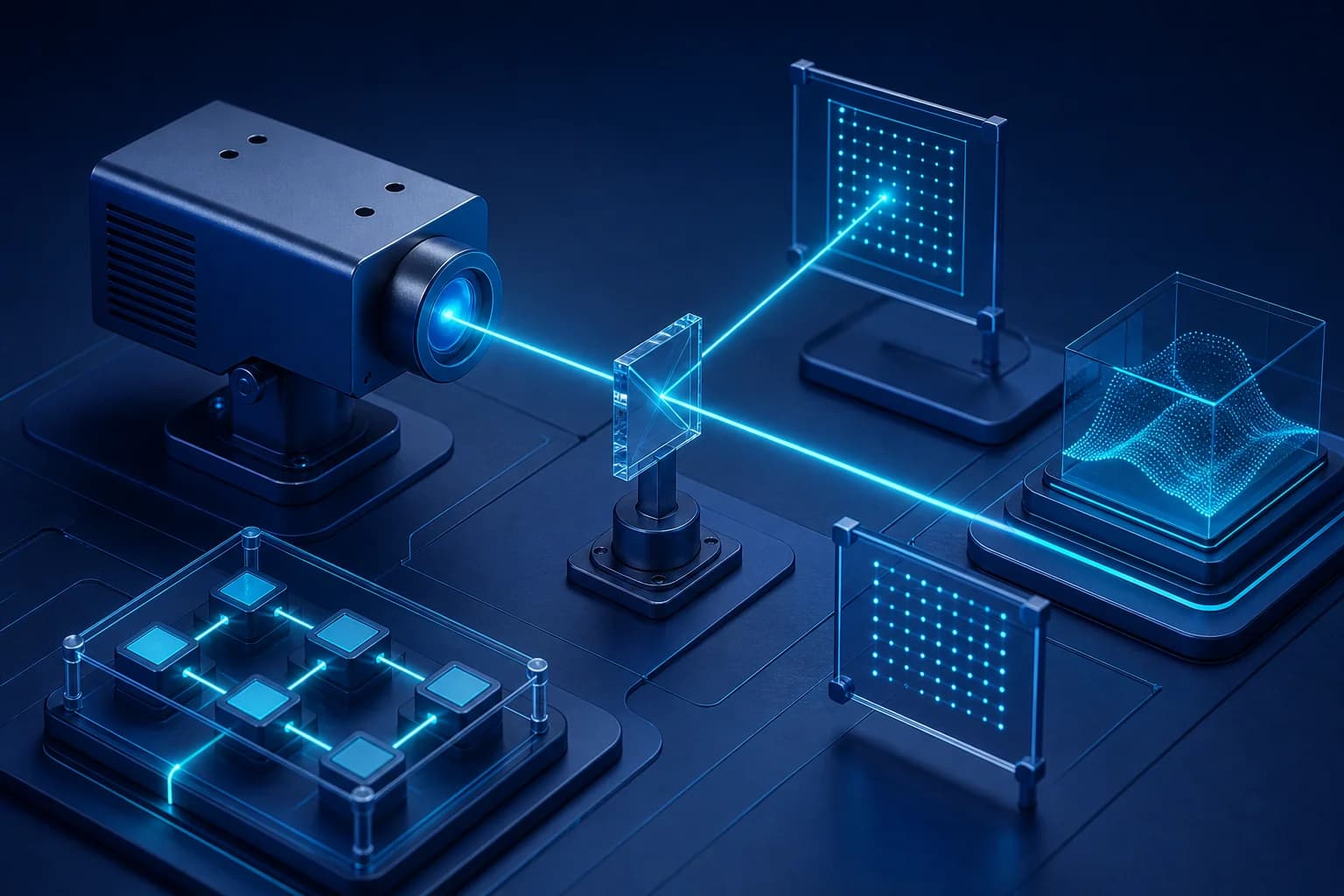
Galvanometer-based laser systems serve as the primary hardware for industrial micro-machining and precision marking, yet the software infrastructure governing their optical accuracy remains trapped in legacy paradigms. According to the project documentation hosted on the developer platform Dev.to, the standard industry utility, EzCad’s CorFile, relies on a 32-bit Windows architecture that frequently suffers from driver conflicts, proprietary binary limitations, and an inefficient 9-point manual measurement workflow.
OpenGalvoCal emerges as a cross-platform alternative designed to modernize the calibration of F-theta lenses and galvanometer mirrors. By utilizing a Rust and Tauri-based architecture, the project provides a headless command-line interface and a desktop suite capable of performing sub-50-micron corrections across various field sizes. The system replaces manual caliper measurements with automated computer vision, utilizing sub-pixel corner detection of high-density dot or checkerboard matrices.
The underlying mathematical model addresses the inherent physical limitations of laser scanning optics, including tangent distortion and higher-order spherical aberrations. In a standard system, the relationship between angular deflection and linear displacement is non-linear, often resulting in pincushion distortion. OpenGalvoCal applies Thin-Plate Splines and 5th-order bivariate polynomials to decouple these geometric errors from mechanical misalignments, ensuring that the beam positioning remains consistent across the entire marking field.
Physical separation between the X and Y galvanometer mirrors introduces coupled cross-axis distortion, where the Y-axis position influences the X-axis incidence point. The software accounts for this by modeling the effective focal distance differences and correcting for orthogonality skew. Even minor mechanical deviations, such as a 0.2-degree misalignment, can produce significant parallelogram distortions that legacy tools fail to isolate or mathematically resolve.
The architecture supports interoperability by exporting to standard formats, including JCZ binary files, LightBurn configurations, and LinuxCNC kinematics tables. This approach allows for the integration of calibration data without requiring proprietary driver replacements. By adopting an open JSON and YAML schema, the software enables users to inspect and verify distortion metrics that were previously locked within opaque, encrypted binary files.
Community feedback from machine operators highlights the systemic failure of legacy tools, particularly regarding platform inflexibility and coordinate mirroring errors. EzCad’s reliance on deprecated MFC libraries renders it unusable on modern macOS or Linux environments without unstable virtual machines. The reliance on a 9-point grid is mathematically insufficient for lenses with focal lengths exceeding 150 mm, leading to visible bowing between calibration points that users frequently report in technical forums.
The project addresses these gaps by implementing a dual-layer calibration model that separates global affine transforms from local non-linear corrections. This decoupling allows the system to resolve coordinate system alignment and scaling independently of lens-specific aberrations. By automating the capture process through flatbed scanners or high-resolution cameras, the framework eliminates the human error associated with manual data entry, parallax measurement, and line thickness ambiguity.
Mathematical correctness in this context requires a rigorous understanding of the F-theta objective, which is engineered to introduce optical barrel distortion to cancel out natural tangent distortion. Real-world multi-element lenses often deviate from this theoretical linear relationship, causing field curvature where the focal plane curves away from the flat marking surface. OpenGalvoCal provides the necessary computational tools to map these deviations, allowing for precise spot focal plane adjustments that maintain uniform laser fluence.
The significance of this development lies in the democratization of high-precision laser calibration for industrial and artisan users alike. By moving away from closed-source, 32-bit utilities, the software provides a transparent path for correcting complex optical errors that were previously considered unfixable. This shift enables operators to maintain consistent marking quality across diverse hardware configurations, effectively bridging the gap between aging controller software and modern optical requirements.
Future development of the platform focuses on refining the integration of thermal drift compensation, as laser power absorption in optical elements often induces shifting focal lengths during extended operations. As the industry moves toward higher precision requirements in micro-machining, the transition from manual, proprietary calibration to automated, transparent mathematical modeling represents a shift in how optical systems maintain operational integrity. The project remains a critical development for engineers requiring reliable, reproducible performance from galvanometer-based hardware.