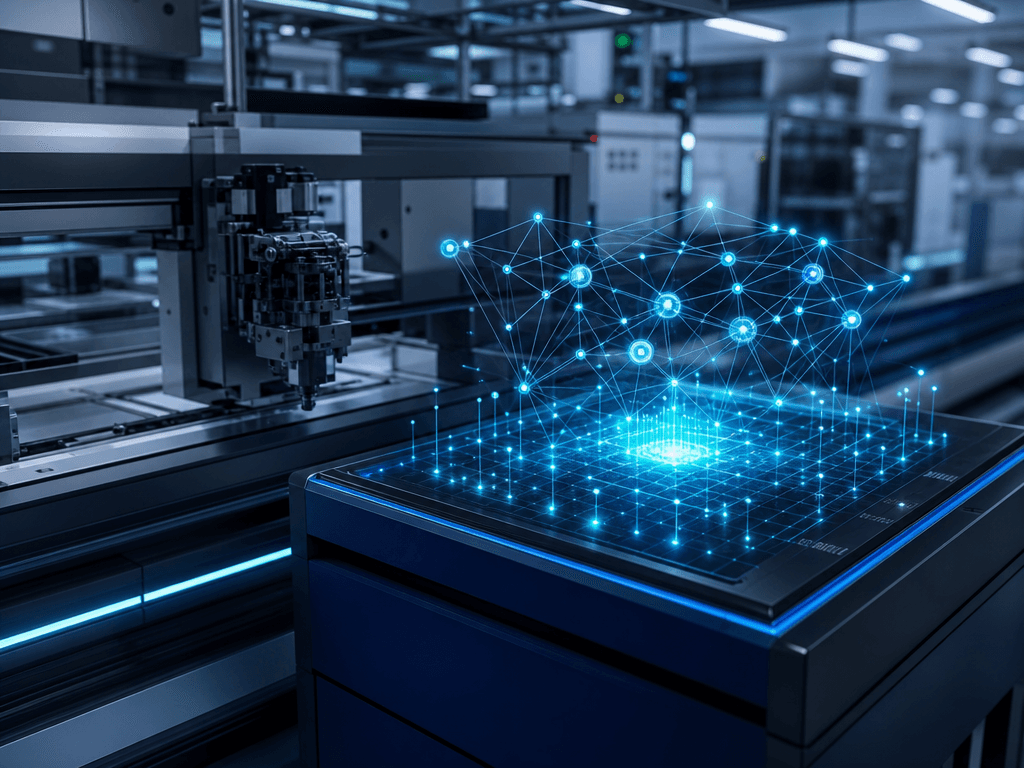
Foxconn has integrated DeepHow’s Live SOP Verification system into its manufacturing infrastructure as of June 2, 2026, marking a shift toward real-time, vision-based process validation. This deployment utilizes the NVIDIA Cosmos vision-language model and the NVIDIA Metropolis Video Search and Summarization (VSS) blueprint to correlate physical human actions with established standard operating procedures.
The system functions by ingesting live video streams to perform semantic analysis of work sequences, moving beyond traditional object detection to interpret complex, multi-step procedural tasks. By mapping real-world execution against digitized SOP templates, the architecture identifies procedural drift at the point of origin rather than through downstream inspection.
This capability relies on the underlying vision-language model to reason over temporal work sequences in high-fidelity industrial settings. Technical benchmarks from the Foxconn facility indicate a 3% improvement in first-pass yield, attributable to real-time guidance provided to frontline workers.
The system achieves 99% task-level accuracy in micro-action recognition, a metric that underscores the efficacy of the underlying model in distinguishing between correct and anomalous procedural steps. Every production cycle undergoes automated analysis, replacing traditional statistical sampling methods with continuous, exhaustive monitoring.
The NVIDIA Metropolis VSS blueprint facilitates the search and summarization of operational data, allowing engineers to perform rapid root-cause analysis when deviations occur. This integration addresses the historical limitation of computer vision systems, which previously struggled to contextualize human movement within the constraints of rigid manufacturing protocols.
By turning frontline execution data into structured operational intelligence, the implementation provides a feedback loop for continuous process optimization. The deployment represents an application of physical AI designed to bridge the gap between theoretical process standards and actual shop-floor execution.
The system architecture supports scalability across diverse production lines, enabling consistent adherence to complex workflows. This methodology shifts the burden of quality control from periodic human audits to an automated, persistent monitoring layer that operates at the speed of the production line.
The integration of NVIDIA Cosmos allows the system to interpret human activity in context, providing a level of nuance previously unavailable in automated quality control. By analyzing work sequences as they occur, the system provides actionable insights for supervisors and continuous improvement leaders.
This data-driven approach ensures that every shift, line, and facility operates within the defined parameters of the approved SOPs. The primary significance of this implementation lies in the transition from reactive defect detection to proactive process guidance.
By leveraging vision-language models to interpret human activity in context, the system provides a mechanism for enforcing procedural compliance in environments where manual oversight is prone to error. This approach mitigates the reliance on end-of-line inspection, which often fails to capture the specific execution nuances that lead to non-conformance.
For AI engineers and manufacturing researchers, the integration highlights the utility of vision-language models in non-generative, high-stakes industrial applications. The ability to reason over video data in real-time allows for the mitigation of procedural drift, which is a critical factor in maintaining throughput for high-value electronics assembly.
This deployment validates the use of specialized blueprints to reduce the complexity of deploying vision-based reasoning in production environments. The implementation also serves as a case study for the broader supply chain excellence initiatives championed by NVIDIA.
By connecting approved SOPs with real-time assistance and AI-driven insight, the collaboration closes the loop between process standards, real-time execution, and operational outcomes. This systematic application of physical AI establishes a new benchmark for operational excellence in complex manufacturing environments.
The long-term impact of this technology will likely be measured by its ability to generalize across different manufacturing domains beyond the current scope. Future iterations will likely focus on increasing the granularity of action recognition and reducing the latency of the feedback loop between the vision model and the worker.
Sustained performance improvements at the Foxconn facility will serve as a primary indicator for the viability of deploying similar vision-centric architectures in other high-precision industrial sectors. The project demonstrates the potential for scaling physical AI across global manufacturing networks.