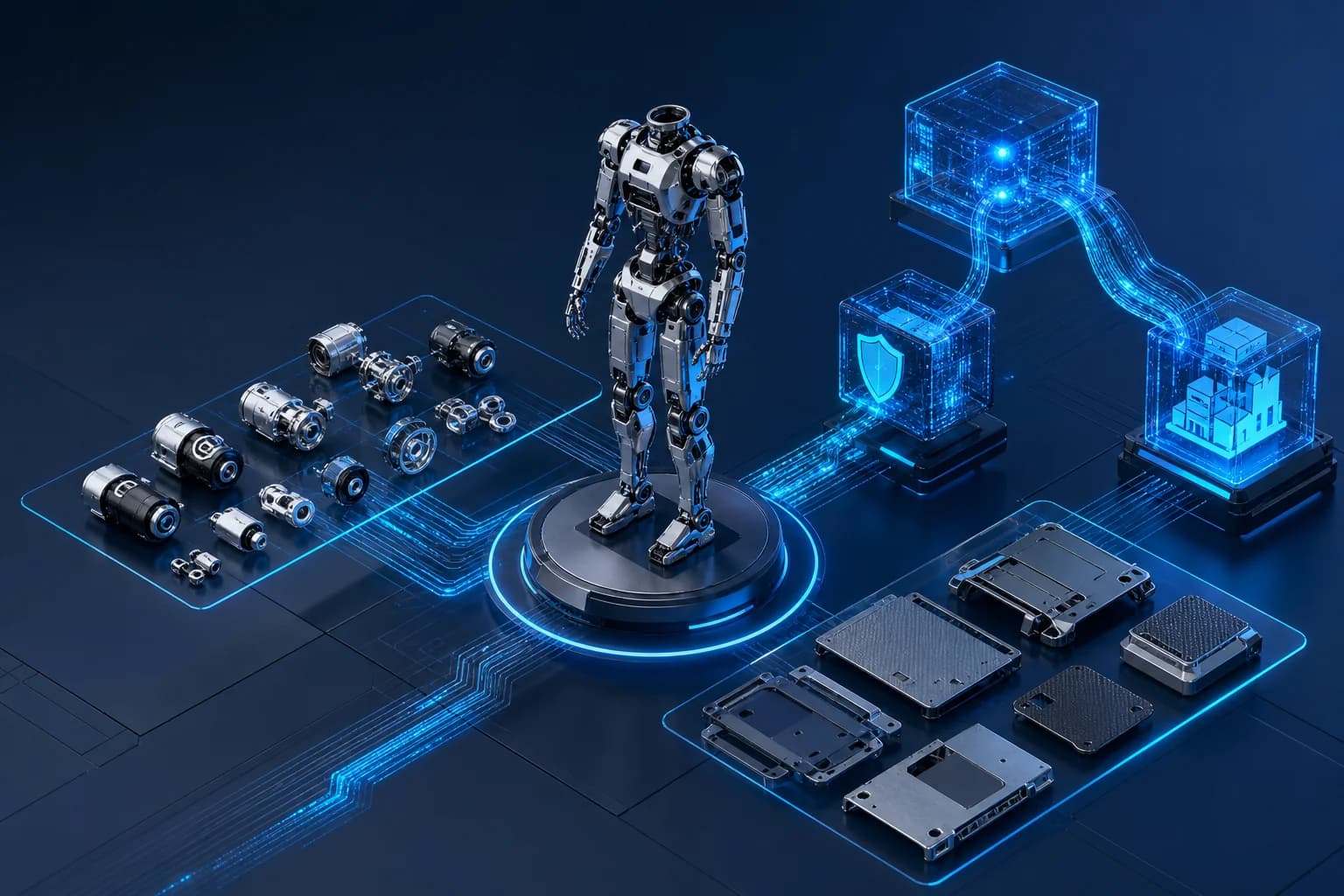
Shanghai-based robotics startup RoboParty has released a comprehensive set of hardware and software documentation for its RP1 humanoid robot, providing researchers with access to SolidWorks CAD assemblies, 14 custom PCB Gerber files, and NVIDIA Isaac Lab reinforcement-learning workflows. This release, which debuted on GitHub following the platform’s public demonstration at the IROS 2026 conference in Pittsburgh, represents a significant move toward open-standard bipedal development.
Founder Yi Huang established the company in early 2025 with a focus on full-stack transparency, building upon the earlier RPO project that garnered substantial community interest. The RP1 platform features a dual-processor architecture, utilizing a Rockchip RK3588 for general application tasks and an NVIDIA Jetson Orin NX 16 GB module to provide 40 TOPS of dedicated AI inference capacity. A secondary 480 MHz real-time MCU manages low-latency motion scheduling and safety protocols, effectively isolating critical control loops from the primary compute stack.
Mechanical design for the RP1 relies on AL6061 and AL7075-T6 aluminum alloys, supporting either 24 or 30 degrees of freedom depending on the configuration. The ROMOMO actuator family serves as the system’s core, employing two-stage planetary gear reduction to deliver up to 160 N·m of peak torque at the hip and knee joints. These modules communicate via a CAN-FD bus, a standard chosen for its high bandwidth and ability to handle 64-byte data frames at bitrates up to 8 Mbps.
The hardware documentation is licensed under the CERN-OHL-W-2.0, which mandates that any modifications to the published designs must be released under the same reciprocal license. This framework allows for the commercial use of the designs provided they remain unchanged, yet it creates a legal bottleneck for developers who intend to integrate these components into proprietary systems. The license specifically targets the hardware layer, leaving the software ecosystem under a separate, more restrictive commercial license that prohibits industrial application.
China’s National Intelligence Law imposes a mandatory obligation on RoboParty to comply with government data requests, a constraint that researchers must account for when deploying the platform in sensitive environments. This legal reality exists independently of the open-source license, meaning that even if the hardware designs are public, the operational data generated by the robot remains subject to state oversight. The intersection of open-source hardware and these specific jurisdictional requirements creates a unique risk profile for international research teams.
The ROMOMO actuator modules represent the most complex aspect of the RP1, as each unit operates its own local control loop for current, velocity, and position. By withholding the firmware source code for these modules, RoboParty prevents third-party developers from modifying the low-level motor behavior or optimizing the torque response for specific locomotion tasks. This design choice forces users to rely on the company’s pre-compiled binaries, effectively creating a hardware-locked dependency that limits the platform’s utility for advanced control research.
The decision to withhold actuator firmware demonstrates a deliberate strategy to retain control over the robot’s physical performance while appearing to support the open-source community. RoboParty provides the mechanical and electrical schematics to encourage adoption, yet it keeps the proprietary control algorithms behind a closed-source wall to protect its competitive advantage in motion stability. This bifurcation of the platform ensures that while the robot’s structure is transparent, its core movement capabilities remain a black box to the end user.
The current software repository includes a ROS 2-based deployment framework and Linux board support packages, yet the core motion-learning framework is restricted by a non-commercial license. This licensing structure limits the utility of the RP1 for industrial applications, effectively confining its immediate use case to academic research and prototyping. The project has secured significant financial backing from investors including CATL, Xiaomi, and SenseTime, reflecting strong institutional interest in the platform’s underlying architecture.
Future adoption of the RP1 will likely depend on the community’s ability to develop independent firmware for the ROMOMO modules or the potential for RoboParty to further loosen its licensing constraints. Observers should monitor the GitHub repository for updates to the firmware documentation and evaluate whether the current hardware specifications are sufficient for third-party integration. The platform’s success hinges on whether the research community can overcome the limitations imposed by the missing firmware and the restrictive commercial usage policies.