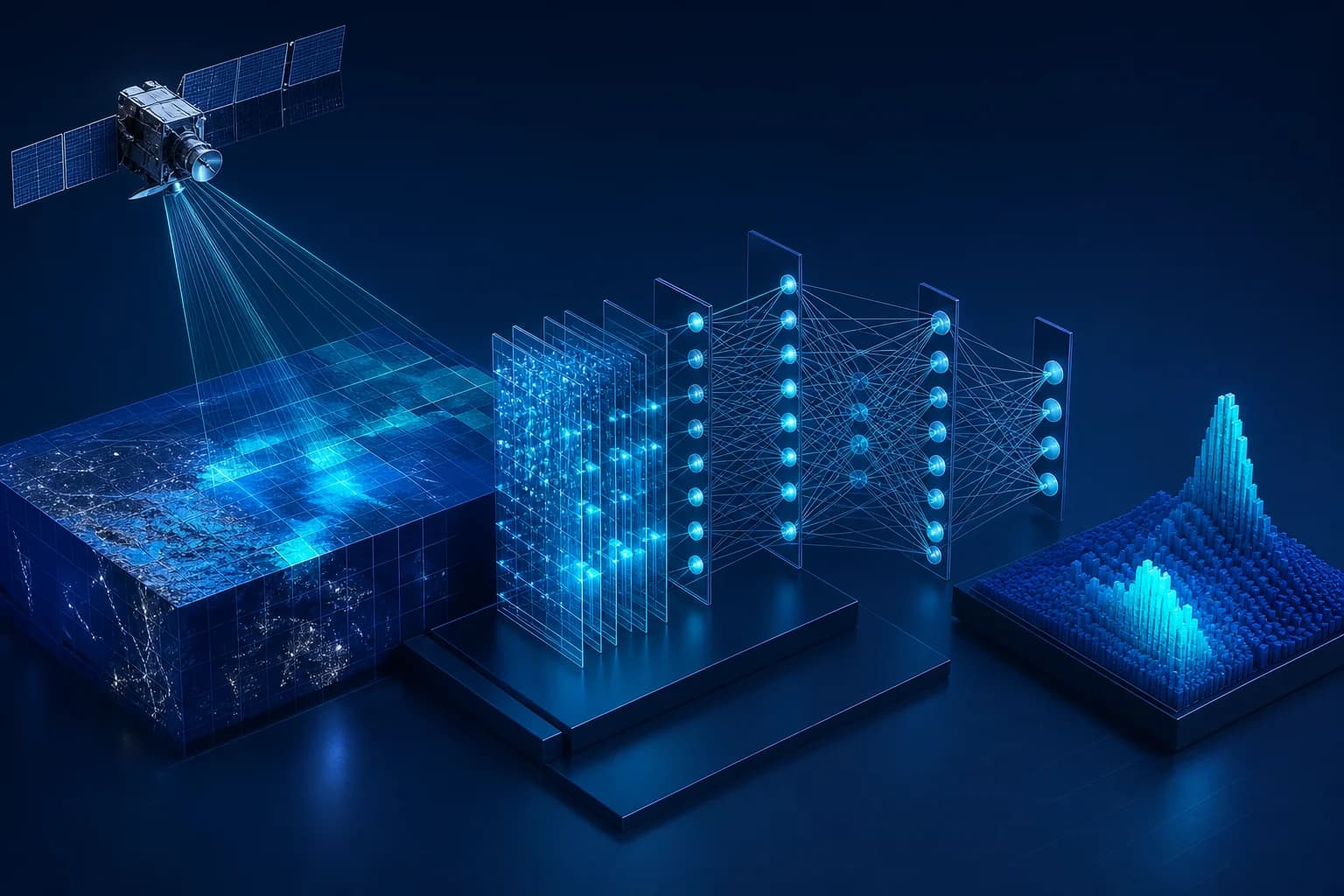
Satellite-based Earth observation faces significant limitations due to the stochastic nature of atmospheric interference and orbital mechanics, which frequently compromise data continuity. A recent review paper authored by Raul-Alexandru Gorgan and Dorian Gorgan of the Technical University of Cluj-Napoca suggests that Liquid Neural Networks offer a viable computational framework to resolve these persistent inconsistencies.
Traditional deep learning architectures often struggle with the irregular temporal intervals inherent in satellite imagery acquisition. These models typically require fixed-length input sequences, a constraint that fails to account for the unpredictable gaps caused by cloud cover or varying orbital trajectories. The researchers argue that current computer vision pipelines are ill-equipped to handle the high degree of noise generated by shifting solar angles and atmospheric scattering. This instability forces engineers to rely on heavy data preprocessing, which often introduces latency and potential information loss. The proposed shift toward liquid architectures seeks to replace static weights with dynamic, time-continuous differential equations.
Liquid Neural Networks function by adjusting their internal states in response to the temporal characteristics of incoming data streams. Unlike standard recurrent neural networks that operate on discrete time steps, these bio-inspired systems maintain a continuous-time hidden state. This architecture allows the model to adapt its parameters based on the specific cadence of the observation, effectively smoothing out the irregularities found in satellite telemetry. The researchers highlight that this adaptability is particularly beneficial for multi-modal sensor fusion where data arrival times are rarely synchronized. By treating the input as a continuous signal rather than a series of snapshots, the model maintains a more coherent representation of the observed environment.
The technical implementation relies on the ability of these networks to learn the underlying dynamics of the data rather than simply mapping static inputs to outputs. This approach reduces the reliance on massive, labeled datasets that are often difficult to curate for specific orbital conditions. The authors emphasize that the system’s efficiency stems from its compact parameter count, which facilitates deployment on edge-computing hardware aboard small satellites. This capability is essential for real-time processing where bandwidth constraints limit the volume of raw data transmitted to ground stations. The research suggests that the inherent flexibility of liquid models provides a robust alternative to the rigid structures of traditional convolutional neural networks.
The transition to these dynamic models represents a departure from standard training methodologies in computer vision. Instead of optimizing for a static loss function across uniform batches, the training process for liquid networks involves solving differential equations that describe the system’s evolution over time. This requires specialized solvers that can handle the computational complexity of continuous-time updates during backpropagation. The researchers note that while this increases the initial training burden, the resulting model exhibits superior generalization across diverse geographic and atmospheric conditions. This performance gain is critical for applications requiring high-fidelity monitoring of environmental changes over extended periods.
The broader implications for remote sensing involve a shift toward autonomous, on-orbit data interpretation. By embedding intelligence directly into the satellite platform, operators can prioritize the transmission of anomalous or high-value data, thereby optimizing limited downlink resources. The researchers identify this as a necessary evolution for constellations that must maintain consistent monitoring despite the inherent unpredictability of orbital environments. This integration of time-aware AI architectures could redefine the standards for satellite-based environmental analysis and disaster response.
The academic community is now looking toward empirical benchmarks to validate these theoretical advantages in operational settings. Future research will likely focus on the scalability of these models when applied to hyperspectral imagery and high-resolution synthetic aperture radar data. The ability to maintain temporal coherence across these varied modalities will be the primary metric for determining the long-term viability of liquid architectures in space-based applications. The transition from controlled simulations to real-world orbital deployment remains the definitive milestone for this technology.