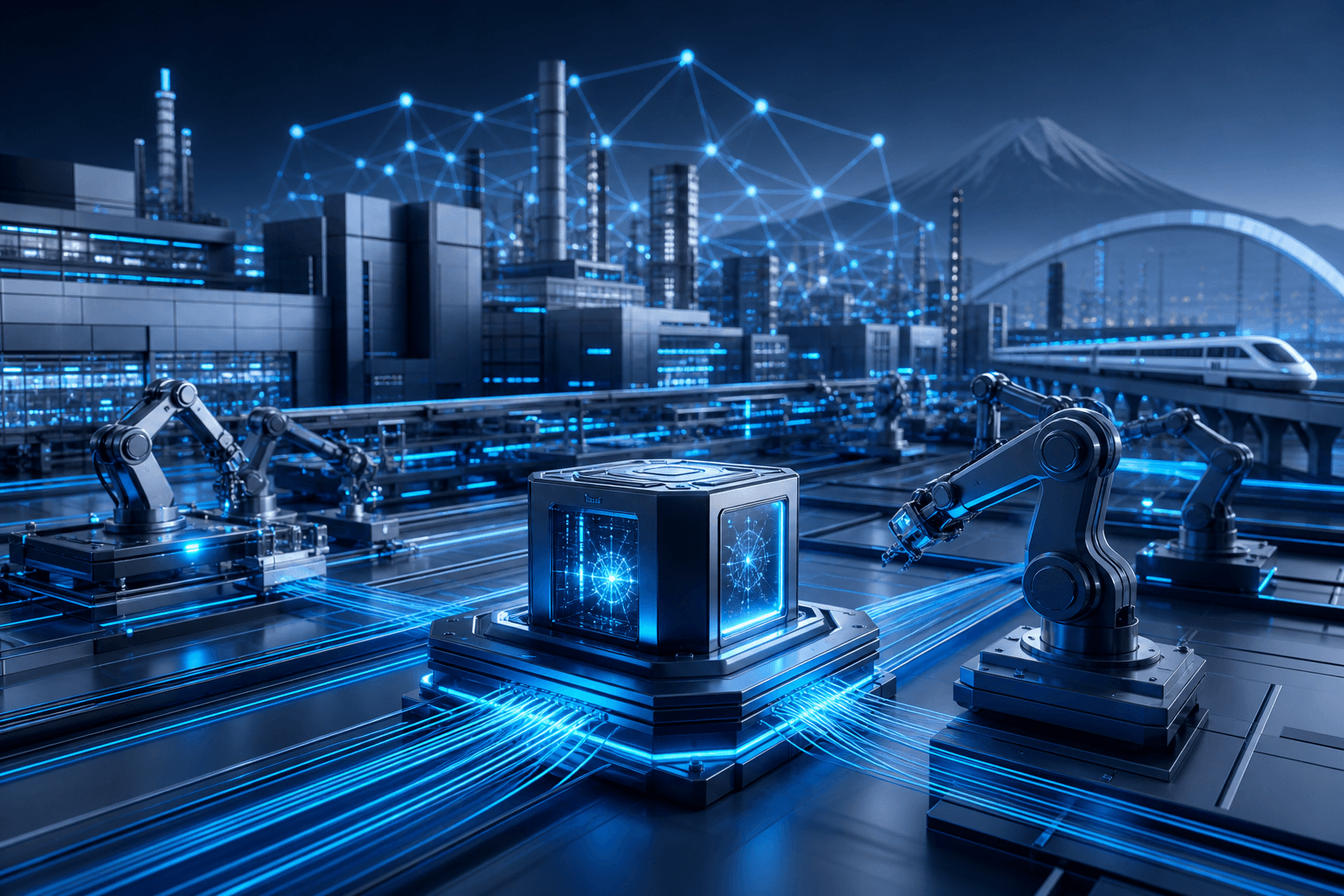
Japan is formalizing a national strategy to integrate physical AI into its industrial base, moving beyond isolated software experiments toward a cohesive, full-stack economic model. This initiative, supported by the Ministry of Economy, Trade and Industry, coordinates research and deployment across robotics, digital twins, and autonomous agents using NVIDIA accelerated computing infrastructure.
The strategy leverages Japan’s established expertise in mechatronics and precision engineering, augmenting these capabilities with locally adapted foundation models. By customizing open Nemotron models for specific industrial workflows, Japanese enterprises are prioritizing data sovereignty and regulatory compliance over reliance on general-purpose cloud architectures. The framework unites government data initiatives with private sector manufacturing, creating a pipeline for developing multimodal foundation models tailored to industrial environments.
Key industrial players including Fujitsu, FANUC, and Kawasaki Heavy Industries are integrating NVIDIA technologies to modernize production lines and robotic systems. During a recent visit to Tokyo, NVIDIA chief executive Jensen Huang engaged with executives from 16 major semiconductor and component firms, including Tokyo Electron and Mitsubishi Electric, to align supply-chain capacities with the requirements of physical AI. This collaboration aims to embed intelligence directly into the machinery and infrastructure that underpin the national economy.
Toyota is expanding its application of NVIDIA platforms, utilizing the DRIVE AGX architecture and the safety-certified DriveOS for L2++ advanced driver assistance systems. The manufacturer is also employing Megatron-LM and NVIDIA Nemotron datasets to refine MISRA-compliant code-assistant models, ensuring that generated software meets rigorous safety and reliability standards. These tools facilitate automated code review and generation, enhancing engineering efficiency while maintaining human accountability in safety-critical vehicle operations.
Operational efficiency in manufacturing is being addressed through the application of NVIDIA Omniverse libraries and the Isaac Sim framework. Toyota uses these tools to simulate robotic movements and production layouts within digital twin environments, allowing for the identification of mechanical interference before physical commissioning occurs. This simulation-led approach reduces downtime and enables production teams to optimize factory configurations without disrupting live manufacturing processes.
Woven by Toyota has developed a multimodal vision-language model for urban traffic intelligence, utilizing NVIDIA H100 GPUs and Megatron-Core. This system interprets complex real-world conditions to support decision-making across transport networks, shifting the focus from individual vehicle detection to broader operational context. The integration of these vision-language models allows road authorities to anticipate traffic developments and coordinate responses across urban infrastructure more effectively.
Edge computing serves as a foundational element of this physical AI architecture, addressing the latency requirements of autonomous systems that cannot rely on continuous cloud connectivity. The introduction of NVIDIA Jetson T3000 and T2000 modules provides Blackwell-based compute capabilities in compact configurations, offering 865 FP4 teraflops of AI compute. These modules support high-performance inference at the edge, enabling robots and mobile equipment to perform navigation and collision avoidance tasks with millisecond-level precision.
Physical AI will bring intelligence to every moving machine from cars, robots and trucks to the cities and factories they operate in. Together, Toyota and NVIDIA are building the AI infrastructure for a new era of mobility, where vehicles can become more autonomous, manufacturing more AI-defined and urban environments more intelligent, responsive and safe.
This statement from Rishi Dhall, vice president of automotive at NVIDIA, highlights the shift toward agentic systems that operate across physical domains. The integration of edge processors with centralized simulation tools represents a significant move toward autonomous, self-optimizing industrial environments. By embedding intelligence into the physical layer, these systems move toward a state where infrastructure and machinery can autonomously adapt to operational demands.
Future development will focus on the scalability of these multimodal foundation models within regulated industrial environments. The success of this initiative depends on the ability of Japanese firms to maintain high standards of safety-critical software engineering while increasing the autonomy of their robotic and transport assets. Observers will monitor the transition from simulation-based validation to large-scale field deployment across Japan’s rail and manufacturing sectors.