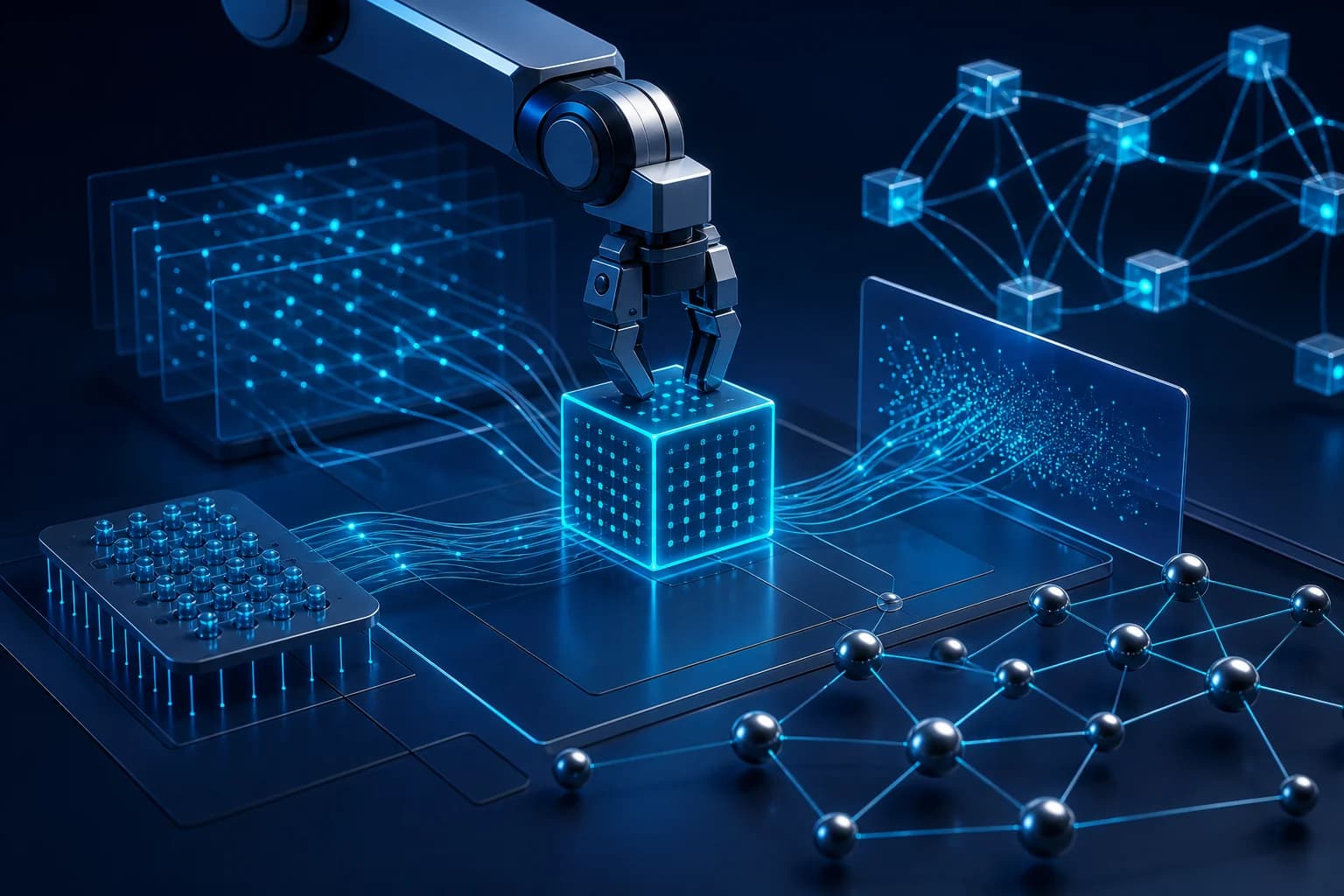
Daimon Robotics has introduced Daimon-TWM, a tactile-grounded world model designed to shift robotic perception from purely visual inputs to a framework that prioritizes physical interaction data. The system addresses a persistent bottleneck in embodied AI where visual-only models fail to calculate the precise force, friction, or deformation required for delicate manipulation tasks.
The architecture functions by integrating tactile signals directly into the robot’s decision-making loop, allowing for real-time adjustments during physical contact. This approach marks a departure from traditional control systems that rely on reactive force feedback, instead utilizing predictive modeling to anticipate interaction outcomes before and during the manipulation process. Daimon-TWM represents an evolution of the company’s previous Vision-Tactile-Language-Action (VTLA) architecture, which sought to fuse disparate sensor modalities into a unified control scheme.
The technical challenge of training such a model lies in the scarcity of high-fidelity tactile datasets compared to the vast repositories available for text or image processing. To overcome this, the firm is leveraging its Daimon-Infinity initiative, a multimodal embodied AI data project that utilizes proprietary vision-based tactile sensors. These sensors capture high-resolution contact data, which is then synchronized with visual perception and motor action logs to train the model on complex physical interactions.
Daimon-TWM utilizes a specialized neural network structure that processes tactile input streams at a higher sampling frequency than standard visual frames. This high-frequency processing ensures that the model can detect micro-slippage and subtle surface deformations in milliseconds, providing the necessary latency reduction for stable grasping. By mapping these tactile inputs to a latent space shared with visual data, the model achieves a more comprehensive understanding of the physical environment.
The training methodology involves a combination of supervised learning on human-demonstrated tasks and reinforcement learning in simulated environments. This dual-path approach allows the model to learn from diverse physical scenarios, including handling fragile glass, organizing items in refrigerators, and preparing food. The resulting model demonstrates improved success rates in contact-intensive tasks where visual occlusion often prevents traditional robots from completing the objective.
Demonstrations of the model highlight its capability to handle deformable or contact-sensitive objects, such as glassware and food items, within unstructured environments like refrigerators. By training on these specific contact-intensive tasks, the system learns to differentiate between materials and adjust grip pressure dynamically. This capability is essential for applications in manufacturing and logistics where robots must interact with objects that lack predefined physical properties.
The company, which originated from a research team at the Hong Kong University of Science and Technology, has secured significant capital to scale its R&D efforts. In August, Daimon Robotics closed a strategic financing round led by Ant Group, following a 100-million-yuan Series A round earlier in the year. These investments support the development of a full-stack robotics ecosystem that includes hardware sensors, data-acquisition systems, and the underlying tactile-native AI models.
The integration of tactile data into world models suggests a broader shift in robotics toward physical intelligence as a primary metric for performance. By grounding AI in the physics of contact, researchers aim to move beyond the limitations of visual observation, which often fails to account for the hidden variables of material science and mechanical resistance. This transition is critical for the development of robots that can operate reliably in environments where visual occlusion or lighting variations might otherwise compromise performance.
The reliance on multimodal data acquisition signifies that the future of dexterous manipulation may depend more on the quality of physical datasets than on the scale of visual training alone. As the industry moves toward more sophisticated embodied AI, the ability to synthesize tactile feedback with visual and linguistic inputs will likely become the standard for high-performance robotic systems. The success of this model will depend on the scalability of the Daimon-Infinity data pipeline and its ability to generalize across diverse, non-standardized industrial tasks.
Industry observers should monitor the company’s upcoming technical disclosures regarding the specific training methodologies used to align tactile sensors with the world model. Future milestones include the deployment of these systems into production-grade logistics environments, where the model’s ability to maintain precision under high-throughput conditions will be tested. The long-term efficacy of this approach remains contingent on how effectively the model translates tactile inputs into stable, repeatable motor control sequences.